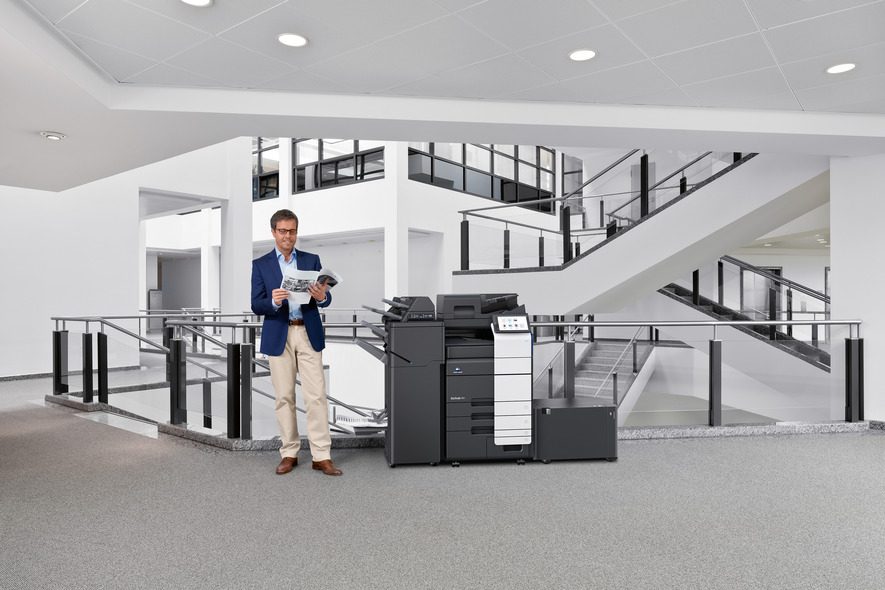
There are three ways to get printers into a business. You can buy them outright, lease them through a finance company, or move to a managed print service. Each suits a different kind of business. Price is only one part of the decision. Buying gives you ownership and full control, along with every fault, supply order and upgrade decision. Leasing spreads the cost, but usually ties you to a finance company that is separate from whoever services the devices. Our managed print service puts devices, servicing, supplies and support into one agreement.
We also fund the equipment ourselves. That means one company and one contract.
Each route has trade-offs. Below, all three are compared on control, flexibility, support and risk, along with the situations where buying outright is the better choice.
Three ways to get printers into your business
Buying outright
Buying outright means your business owns the device from day one. You pay for it upfront and decide how it is used, serviced and replaced. Servicing, toner and repairs are either arranged separately with a supplier service agreement or handled in-house. Ownership brings control. It also brings every problem.
Leasing through a finance company
With a third-party lease, a finance company owns the device and you pay them for its use over a fixed term. The dealer who supplied the device usually services it under a separate agreement. Many businesses don’t realise they have two contracts with two different companies. That catches people out. In many cases, the lease runs on regardless of how the service side performs.
Lynbrook’s Managed Print Service
A managed print service bundles devices, servicing, parts, toner, monitoring and support into one agreement with one monthly invoice. You stop managing printers and simply use them. Some managed print providers still use a third-party lender to fund the equipment. Lynbrook doesn’t. We fund our own fleet, so your agreement is with us alone.
Managed print vs buying vs leasing: side-by-side comparison
The table below compares the three routes on what matters day to day. It leaves out price on purpose. The right answer depends on how your business works.
| Buying outright | Third-party lease | Managed print with in-house finance (Lynbrook) | |
| Upfront outlay | Full cost upfront | Spread over the term | Spread over the agreement |
| Who you deal with | You, plus any service supplier | A finance company and a separate service supplier | One provider |
| Servicing and repairs | Arranged separately or done in-house | Usually a separate service agreement | Included, with one visit, one fix |
| Toner and parts | Bought as needed, or part of a Service Agreement | Usually with a separate Service Agreement | Included |
| Changes mid-term | Buy another device | Often fixed until the term ends | Upgrade mid-term and adjust as you grow |
| Extra fees | None, but your own time | Check for admin, insurance and documentation fees | No annual admin or insurance fees |
| Invoices | Several | At least two | One monthly invoice |
Buying wins on ownership. Leasing helps cash flow. Managed print with in-house finance puts everything with one provider and keeps the agreement flexible. Which matters most depends on your business.
Buying your own printers: pros and cons
Buying works well for some businesses. It tends to suit those with low volumes, stable needs and someone on hand to look after the devices.
The advantages:
- You own the device outright.
- There is no finance agreement to manage.
- You can choose any service or supplies provider.
The drawbacks:
- A large upfront outlay.
- Faults, toner and repairs become your problem.
- Devices age, with no planned refresh.
- Data stored on old devices must be wiped safely before disposal.
Purchased equipment may qualify for tax relief through capital allowances, and GOV.UK explains how the annual investment allowance works. Speak to your accountant before deciding.
Leasing through a finance company: what to check before you sign
Leasing can protect cash flow, and plenty of businesses use it well. The detail matters, so before you sign a lease get clear answers to these six questions.
- Who owns the device, and who do we pay? If it’s a finance company, find out who you contact when something goes wrong.
- Do the lease and service agreements end at the same time? Mismatched dates can leave you paying for one without the other.
- Are there extra fees? Ask about annual admin fees, insurance charges and documentation fees.
- Can we change things mid-term? With a 3rd party lease you will often have to settle the existing agreement and start a fresh. Find out what happens if you need to add, upgrade or remove devices.
- What if the service provider stops trading? The likelihood is that the lease payments will continue regardless and you will need to source a new service
- What happens at the end? Ask about return, extension and upgrade options, and any notice period.
Clear answers are a good sign. Vague ones are worth pushing on.
We regularly speak to businesses and organisations that are tied into third-party leasing agreements, even though their equipment no longer meets their needs or the service they receive falls well below expectations. In these situations, replacing the equipment immediately is not always financially viable, but continuing with an unreliable print fleet can be costly and disruptive.
One example involved a secondary school with a large fleet of ageing print equipment. When a new lease agreement had been arranged, much of the previous equipment had been retained, leaving the school with a fleet where the majority of devices were already seven years old. The service agreement was tied to the new lease, with a further three years remaining.
The ageing equipment suffered frequent breakdowns, while poor service levels meant that some essential devices could be out of action for more than a week. This created significant disruption for staff and placed additional pressure on the school’s day-to-day operations.
After reviewing the school’s contractual agreements, we established that terminating the arrangement early was not financially viable. Rather than simply recommending new equipment, Lynbrook worked with the school to develop a practical exit strategy.
We helped manage the transition over time and provided reliable temporary equipment to minimise disruption while the existing agreement remained in place. This gave the school a way to overcome the immediate problems while planning for a longer-term solution. When the time was right, we supported the school in bringing the agreement to an end and moving forward with a print solution better suited to its needs. The school has now been a valued Lynbrook customer for five years, and its Business Manager remains a strong advocate of our service.
It’s a good example of our approach: we look at the whole situation, provide honest advice and work with customers to find a solution that makes commercial sense, even when the answer isn’t simply to replace their equipment straight away.
Managed print with in-house finance: how it differs
Lynbrook funds its own equipment. There’s no leasing company in the background, which changes the terms in your favour. Your devices, servicing, supplies and finance all sit with one provider.
In practice, that means:
- One company to deal with
- No annual admin fees and no insurance fees.
- Equipment that can be upgraded mid-term if your needs change.
- An agreement that adjusts as your business grows.
- Service and rental on one monthly invoice.
- Short-term rental for equipment you need briefly, and on-hire, off-hire arrangements for project sites in sectors such as construction.
- One visit, one fix support, with every engineer carrying at least £5,000 of stock.
Read more about how in-house finance works. Our managed print service page covers everything that’s included, from the printers and multifunctional devices themselves to supplies and support.
How to decide: five questions to ask
- How many devices do we have, and how much do they print? Our seven-step print waste check will give you a rough answer.
- Who handles faults and supplies today, and how long does it take them?
- How likely are our needs to change over the next few years?
- Would we rather pay upfront or spread the cost?
- Who will we be contracted to, and for what?
Answer those honestly and one route usually stands out.
Compare more than the monthly price
The cheapest route on paper isn’t always the best value. Who you’re contracted to, how flexible the agreement is and who fixes things when they break all matter as much as the monthly figure. Get those right first. Book a free print audit and we’ll show you which route fits your business.
Frequently asked questions
Is managed print worth it for a small business?
It depends on your setup. For a business with one printer and light use, buying may be simpler. Once you have several devices, several suppliers or regular faults, managed print usually saves time and hassle.
What affects the cost of a managed print service?
The number and type of devices, print volumes, colour use, software and the level of support all play a part. Quotes are rarely like for like. Compare what’s included, not just the monthly figure.
What’s the difference between a printer lease and managed print?
A lease only finances the device. Managed print covers the device, servicing, parts, toner and support in one agreement. With Lynbrook, the finance is in-house too, so there’s no separate leasing company.
Can I switch to managed print before my lease ends?
When we first visit a business, it’s not unusual to find that there is still time remaining on its existing print lease. However, this doesn’t necessarily mean you have to wait until the agreement expires before exploring a better solution. Depending on the remaining term and the cost of settling the agreement, Lynbrook can assess the options and help plan a managed transition to our services.
In many cases, we can structure the move so that you benefit from improved equipment and service without increasing your overall costs or placing an additional financial burden on your business.
The important thing is to understand your options. We’ll review your existing arrangements, explain what may be possible and help you find a practical way forward, even if you’re still tied into a contract.
Do I own the printers under managed print?
No. With Lynbrook, we fund and own the equipment, and you use it under your agreement. That’s what makes upgrades and mid-term changes possible.